Relational Patterns and How They Shape Your Everyday Life
Have you ever thought that most of what you do in your everyday life comes from certain repetitive programs your mind created at some point?
The less pleasant part is that many of these programs are negative and sabotage our relationships as well as the goals we want to achieve, including the choices we make. And one of the choices we make unconsciously involves the relationships and the people we interact with.
Have you ever wondered why you attract, at work or in your close circle, people you'd normally and rationally never want around you? Maybe someone verbally aggressive, self-destructive, domineering, or nagging?
Well, it turns out that sometime during early childhood, up to around age 6 or 7, our unconscious mind formed an image of what a family and its members should look like. And this image is made up of the sum of the people who cared for us during that period and who influenced us the most.
As adults, in our first romantic relationships, the criteria by which we choose the person we'll form a couple with tend to carry those very traits from our unconscious program — the sum of the positive and negative traits of the people who influenced our childhood.
You might wonder — why the negative traits too?
Studies in the field say that we largely choose those people because of their negative traits, because during childhood, the people who marked us sometimes behaved toward us in a way that made us suffer.
In practice, we suffered certain emotional wounds as a result of events that left their mark on us. And since nature seeks to balance things out, it helps us encounter those same people again, through others who share characteristics similar to the ones who influenced us when we were little.
But now, as adults, we can see things differently, and in a confrontation or emotional discomfort with those people, those old emotional wounds surface, and we often react not to what's happening in the present, but actually to what happened in the past.
For example, on an ordinary day at work, you suddenly feel a deep longing for your partner and call them. But their secretary answers and says your partner is out and can't be reached. Suddenly those loving thoughts vanish and unease sets in: "Where could they be?" You think maybe they're in a meeting with a client or their boss, yet a part of you feels abandoned.
Just because your partner isn't available exactly when you're looking for them, you feel as abandoned as when your mother left you for a whole day in the care of a neighbor or an unfamiliar babysitter. The old brain is essentially stuck in the past, and any resemblance in the present makes you react as you did back then — and what's needed is a "software" update, and that update is exactly what makes the difference between healthy relationships and unhealthy ones.
Often, too, we spend an entire lifetime trying to become something or someone: a doctor, a singer, an engineer — for our mother or father. And after we reach that dream we believed was our own, frustration creeps in because we no longer know who we are or what we want. When in fact, that's precisely when we're free — and we don't know what to do with that freedom.
Another example: when I was little, others used to laugh at me, and I wished that when I grew up I'd have power and could show them who I really am. That can translate today into holding an important position and showing my subordinates who I am through harshness and strictness, so they won't laugh at me — the same thing happens with a partner: I don't show them how I really feel, so they won't laugh at me either.
Now, if you look at yourself and at the last few days of your life — even just the last 48 hours — what patterns do you think influenced the choices you made, and how did they help you? And if you look at things now with some distance, would you still make the same choices?
Also think about the system you're part of: whether it's your job, school, or circle of friends — who in it resembles people from your life or your childhood?
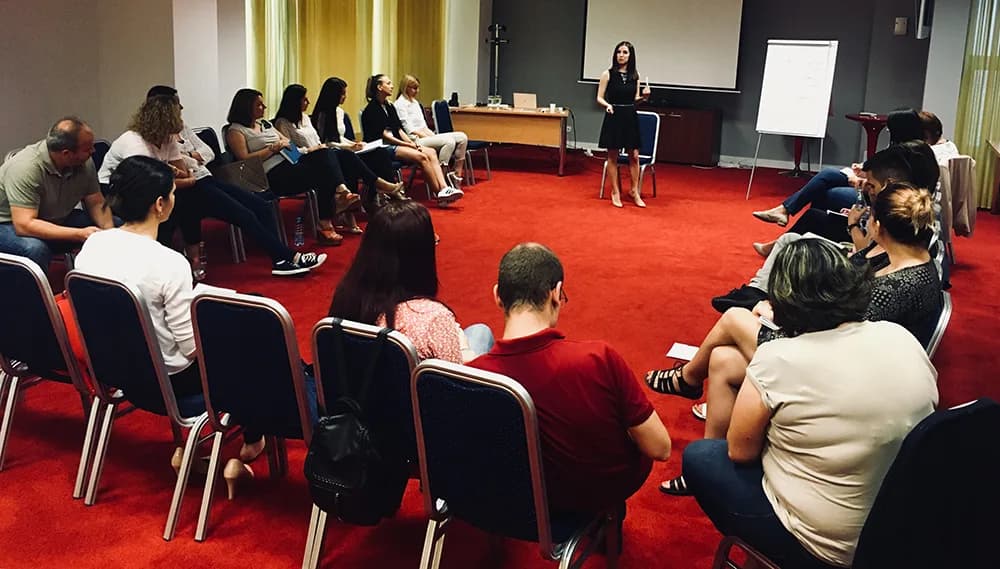
Last week I led a workshop on the topic of "Relational Inheritance," where together we worked on and uncovered those relational patterns we picked up from our parents and from those around us without even realizing it.
Patterns that unconsciously influence our life, and the choices and decisions we make every day.
It was a few intense hours, with beautiful, open people whom I want to thank and congratulate for taking this step toward understanding and improving the relationships in their lives.
My dream is to help build a better world by improving the relationships between us. I believe there's far too little education on this topic, and yet so much suffering caused by the lack of it.
I want to support those who wish to walk this path, so that together we can discover another perspective on relationships — one through which we can understand ourselves and those around us better.
A few pictures from the event.
If you weren't able to make it this time, you'll have another chance in September, when I'll be running this workshop again on September 27th, from 6:30 PM to 9:30 PM, at Hotel Perla.
To register, visit this page: https://ralucanedelcu.com/eveniment-timisoara/
Or if you need more details, you can reach me at 0745547119 or by email at ralucas.nedelcu@gmail.com
Sending you a hug,
Raluca
Clinical psychologist, psychotherapist and ICF-accredited coach at PCC level. I work online with people who want clarity in their career and balance in their life.
Keep reading
How many times have you thought your relationship might end? Safety in a relationship takes many forms — fidelity, financial security, or simply the confidence that things won't fall apart — but at its core, it comes down to trusting yourself to handle whatever comes your way.
A collection of some of my favorite quotes about love and relationships — I hope they inspire you as much as they inspire me.

Have you ever wondered why you have a positive relationship with some people, and are constantly in conflict with others? It might be less about incompatibility than about the part you play yourself.